Foreign Worker Passes Away: What Malaysian Employers Must Do
When a foreign worker passes away, an employer faces an immediate combination of regulatory duties, consular protocols, and statutory claims.
Handling police reports, embassy clearances, and dependants’ welfare while managing a grieving workplace can feel overwhelming.
What you must do as an employer depends on the cause of death. It may stem from a workplace incident, an occupational illness, or a non-work-related cause.
This eInsurans guide outlines the legal, financial, and logistical steps Malaysian employers must execute from the first hour through final account closure.
Key Takeaways:
- Workplace incident reporting: Fatalities at work require immediate site preservation, notification to DOSH/JKKP, and Form JKKP 6 within 7 days.
- SOCSO repatriation benefit: A death claim filed with SOCSO unlocks up to RM7,500 combined or up to RM3,000 for local burial.
- Occupational vs natural illness: Work-related deaths require Form JKKP 7 within 7 days; non-work natural deaths bypass DOSH and go directly to SOCSO’s Invalidity Scheme.
- Immigration closure: Cancel the VPTE/PLKS with JIM and the death certificate to release your bond or FWIG.
- SPIKPA hospital claims: SPIKPA indemnifies unsettled inpatient hospitalization and surgical bills at Malaysian government hospitals up to RM20,000 annually.
Seven Phases of Employer Duty Following a Foreign Worker’s Death
This seven-phase process walks Malaysian employers through a foreign worker’s death: immediate actions, DOSH notification, civil documentation, repatriation or burial, SOCSO claims, SPIKPA and EPF settlement, and immigration pass cancellation.
A closing section covers supporting the family and settling the worker’s final wages.
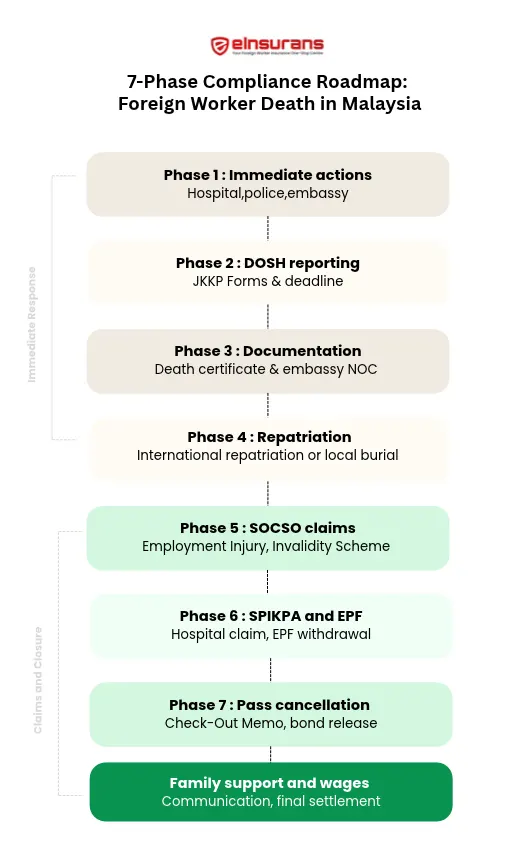
Key terms used throughout this guide:
- DOSH: Department of Occupational Safety and Health, or JKKP
- SOCSO: Social Security Organisation, otherwise known as PERKESO
- VPTE: the worker’s Visit Pass (Temporary Employment) or PLKS
- JIM: Immigration Department of Malaysia
- FWIG: Foreign Worker Insurance Guarantee
- SPIKPA: Foreign Worker Hospitalization and Surgical Insurance Scheme
- EPF: Employees Provident Fund, also known as KWSP
Phase 1: Immediate Actions and Scene Management (The First 24 Hours)

Magnific
The location and cause of death dictate your immediate legal obligations after a worker passes away. Your first actions depend on which of the following scenarios applies:
- Workplace or construction site fatality: Preserve the scene undisturbed under the Occupational Safety and Health Act 1994 (Act 514). You may only alter it to prevent further injury, rescue lives, or maintain essential public utilities.
- Death outside a hospital: Call emergency services and the nearest Royal Malaysia Police (PDRM) station immediately. Police will inspect the location, issue an investigation report, and arrange transfer to a government hospital mortuary for a mandatory post-mortem.
- Death during hospital treatment: The attending physician handles initial clinical notifications.
- Embassy or high commission: Notify them within 24 hours of receiving medical confirmation. The embassy provides consular instructions, helps communicate with the next of kin, and often verifies supporting documents before forwarding a claim to SOCSO.
Confirm claims-verification procedures with the specific embassy involved, since they vary by country. This establishes the immediate reporting trail required before filing statutory accident notices.
Phase 2: Mandatory DOSH (JKKP) Reporting
Workplace fatalities require strict reporting under the Occupational Safety and Health (NADOPOD) Regulations 2004.
Non-compliance carries fines up to RM10,000, up to 1 year imprisonment, or both (and up to RM500,000 under amended OSHA provisions).
Employers must immediately notify the state DOSH office by phone or fax, followed by statutory written submissions:
- Workplace accidents: Submit Form JKKP 6 (Notification of Accident and Dangerous Occurrence) to DOSH within 7 days.
- Occupational illnesses: Submit Form JKKP 7 (Notification of Occupational Poisoning or Occupational Disease) within 7 days for deaths from hazardous exposure or poisoning.
- Internal record keeping: Record the incident in your safety register and submit Form JKKP 8 by 31 January of the following year.
Non-work-related natural deaths do not need to be reported to DOSH (Act 514). Instead, file directly with SOCSO’s Invalidity Scheme (Act 4) for the family’s survivor benefits.
Police verification is still required for a Burial Permit (JPN.LM02) to rule out foul play. |
Once administrative reporting is underway, employers must gather official civil records to authorize body transit.
Phase 3: Civil Documentation and Embassy Clearance

Magnific
Secure certified civil documents before a body can be released for international transit or local burial. The chain runs through three documents in sequence:
- Cause of Death Certificate (Borang 8): The government hospital pathologist issues this after completing the autopsy or clinical evaluation.
- Malaysian Death Certificate (Sijil Kematian): Submit the Borang 8, original police report, and the deceased worker’s original passport to the National Registration Department (Jabatan Pendaftaran Negara or JPN) within 5 days. JPN will issue the official death certificate alongside the final Burial / Cremation Permit.
- No Objection Certificate (NOC): Submit certified copies of these documents to the worker’s embassy. The embassy issues the NOC only after confirming the legal next of kin’s written consent regarding final arrangements.
Verify that the worker’s name and passport number match their immigration records exactly, since a mismatch can delay every document in this chain.
Having verified civil records ready avoids costly customs holds at international airport terminals.
Phase 4: Repatriation of Remains or Local Burial Logistics
The legal next of kin holds exclusive authority to decide between international repatriation and local burial. Employers must obtain an embassy-authenticated declaration of the family’s wishes before making commercial mortuary arrangements.
- International repatriation: Engage a licensed mortuary repatriation service. The provider manages embalming, coffin preparation, and the transit permits required from the Ministry of Health Malaysia. Commercial carriers also require full customs, consular, and health clearance certificates before booking transit.
- Local burial or cremation in Malaysia: Coordinate with local religious bodies that align with the worker’s faith. Ensure the embassy issues a formal release letter authorizing local rites to avoid future legal disputes.
Phase 5: Filing SOCSO Claims
Statutory schemes give foreign workers in Malaysia funeral support and ongoing pensions only if they held a valid work pass at the time of death. This makes accurate, current permit records an ongoing employer responsibility.
SOCSO provides distinct statutory benefits based on the circumstances of the worker’s death, as detailed on SOCSO’s official foreign worker protection page:
Key Details | Key Details | Key Details |
Employment Injury Scheme | Workplace accident or occupational disease | Submit Form 21 within 48 hours, then Form 34-PA (Foreign Worker Notice and Benefit Claim Details).
Dependants’ Benefit: 90% of average daily wage (RM30-RM178.50/day), split 3/5 to spouse for life and 2/5 to children until 21, marriage, or first-degree completion. |
Invalidity Scheme (Skim Keilatan) | Natural, non-work-related death | Effective 1 July 2024. Monthly Survivors’ Pension (Pencen Penakat) based on Act 4 contribution schedules. |
Repatriation and Funeral Benefit | Death in Malaysia | Up to RM7,500 if buried abroad (RM4,500 repatriation + RM3,000 dependants). Up to RM3,000 if buried locally. |
Safety net (Additional Initiative) | Death outside standard scheme coverage, e.g. insufficient contribution history | Reimburses up to RM4,500 in repatriation costs against official receipts. |
Submit certified hospital bills, flight airway bills, police reports, and employer verification forms, and Form 34-PA to your local SOCSO branch or via the ASSIST portal.
SOCSO pays compensation into the eligible dependant’s verified bank account, so accurate banking and identification details are essential.
That concludes SOCSO claim filings; next are SPIKPA and EPF settlement.
Phase 6: SPIKPA and EPF Settlement
This phase covers two separate settlements employers must handle in parallel:
- SPIKPA hospital claims: If the worker was admitted to a Malaysian government hospital before passing away, SPIKPA covers inpatient hospitalization and surgical charges up to the annual RM20,000 policy limit.
- EPF account settlement: For workers contributing to the Employees Provident Fund (EPF), the accumulated savings belong to their legal heirs.
Provide the family with certified employment service letters and death documentation so the embassy can help arrange an EPF Death Withdrawal on their behalf.
That concludes statutory claim filings, leaving final immigration account clearance.
Phase 7: Immigration Pass Cancellation and Security Bond Discharge

Magnific
An employer remains legally responsible for a foreign worker’s regulatory file until the pass is officially canceled with JIM. The cancellation runs through three steps:
- Report the death: Notify the Foreign Workers Division of the Immigration Department as soon as possible after receiving the death certificate.
- Apply for a Check-Out Memo (Memo Pembatalan Pas): Submit the worker’s original passport, death certificate, and flight cargo airway bill or local burial certificate.
- Pass cancellation and record closure: JIM formally cancels the VPTE/PLKS and closes the worker’s record in the system.
This official pass cancellation discharges your employer liability and releases your lodged bank guarantee or FWIG.
Our explainer on what an insurance guarantee is covers how these guarantee instruments function.
Next of Kin Support and Final Salary Remittance

Magnific
Supporting the family and settling the worker’s affairs covers three areas:
- Family communication: Communicating with the worker’s family in their home country requires empathy, dignity, and transparency. Designate a senior HR coordinator or a trusted native-speaking colleague to support consular officers during family briefings.
- Final wage settlement: Calculate and remit all outstanding financial dues within 7 days of the passing, including earned wages, accrued unused leave, and statutory overtime adjustments.
Transfer funds through official consular accounts or directly to the designated legal heir’s verified bank account. - Personal effects: Collect, inventory, and securely package all personal effects and belongings from the worker’s living quarters. Ship these items alongside the mortal remains or hand them directly to embassy officials against a formal sign-off receipt.
Staying Compliant While Supporting Your Workforce
Navigating the passing of a foreign worker requires careful statutory reporting, compassionate family communication, and timely claim settlements.
Following these phases helps keep your business compliant with DOSH, SOCSO, and JIM regulations while honoring the worker’s service. Having the right foreign worker insurance in place speeds up every step.
Any foreign worker still on your payroll faces the same requirement, so confirm SPIKPA IG coverage remains active across your workforce.
Renew or buy SPIKPA IG with eInsurans today to keep your team protected.
Malaysia's Trusted Foreign Worker Insurance One-Stop Centre
SPIKPA IG insurance with seamless FWCMS integration, secure payments, and real human support.