Employer Requirements to Hire Foreign Workers in Malaysia: Compliance Checklist
Employer requirements to hire foreign workers in Malaysia go well beyond offering a role and signing a contract.
Employers must fulfill legal requirements, deadlines, financial commitments, and insurance obligations before a worker can start employment.
Mandatory insurance sits at the heart of this sequence. Without active SPIKPA and IG policies in FWCMS, the Immigration Department will not issue a Visa with Reference, which places insurance among the most time-sensitive compliance gates.
The regulatory landscape has also evolved recently. Since 1 January 2023, Section 60K of the Employment Act 1955 requires prior approval from JTKSM before any non-citizen can be hired.
Since February 2025, the Foreign Workers Centralized Management System (FWCMS) has been the mandatory portal for permit transactions. From 1 October 2025, mandatory EPF contributions extended to non-Malaysian employees.
This guide covers each requirement in the chronological order it applies, from pre-application through to post-arrival obligations.
Key Takeaways
- Compliance is sequential; missing any stage can stall the entire recruitment cycle.
- Section 60K and Act 446 clearances are mandatory prerequisites; applications without them will be rejected.
- SPIKPA and IG policies must be active in FWCMS before the VDR issuance.
- The 24-hour arrival report and 30-day FOMEMA screening remain the employer’s liability; missing either triggers repatriation at employer’s expense.
- SOCSO and EPF contributions apply from the first month of employment.
Key Foreign Worker Terms Every Employer Should Know
Employers should understand key regulatory terms before starting the recruitment process. Misunderstandings about application categories and confusion between approval letters and work permits can lead to issues.
Is There a Difference Between a Foreign Worker and an Expatriate?
In Malaysia, “foreign worker” is a specific legal category, not a generic term.
A Foreign Worker is a low- or semi-skilled non-citizen employed on a Visit Pass – Temporary Employment (VPTE/PLKS). Recruitment is managed through the Foreign Worker Division of the Immigration Department of Malaysia and is limited to approved sectors.
In contrast, an Expatriate is a skilled or managerial non-citizen on an Employment Pass (EP), processed through the Expatriate Services Division (ESD). Quotas, portals, and statutory rules for EPs follow a different framework.
This guide focuses on Foreign Worker (VPTE/PLKS) compliance. Employers hiring on Employment Pass terms should refer instead to the ESD framework.
Core Government Acronyms Employers Should Know
| Acronym | Full Name | What It Is |
|---|---|---|
| JTKSM | Jabatan Tenaga Kerja Semenanjung Malaysia | Peninsular Malaysia Labour Department; issues Section 60K approval |
| MOHR | Ministry of Human Resources | Oversees labour policy and JTKSM |
| KDN/MOHA | Kementerian Dalam Negeri / Ministry of Home Affairs | Approves quota via the One Stop Centre |
| OSC | One Stop Centre | Quota approval centre under KDN |
| FWCMS | Foreign Workers Centralised Management System | The unified government portal for permit transactions |
| VDR / eVDR | Visa with Reference (Calling Visa) | Pre-entry approval issued by Immigration |
| VPTE / PLKS | Pas Lawatan Kerja Sementara | Visit Pass (Temporary Employment); the work permit |
| FOMEMA | Foreign Workers Medical Examination Monitoring Agency | Administers mandatory medical screening |
| FWHS / SPIKPA | Foreign Worker Hospitalisation Scheme | Mandatory medical insurance |
| FWIG / IG | Foreign Worker Insurance Guarantee | Mandatory repatriation cost guarantee |
What Must Employers Prepare Before Applying?

Malaysian employment law requires three core preparatory steps to be completed before using the immigration portal. Missing any of these can lead to application rejection at the earliest stage of the process.
1. Sector and Role Eligibility
Foreign worker recruitment is permitted only in specific sectors approved by the Ministry of Human Resources (MOHR). These currently include manufacturing, construction, plantation, agriculture, services, and mining and quarrying.
In approved sectors, there are restrictions on source countries. For instance, male Indonesian workers are generally excluded from manufacturing, while Indian workers are often limited to roles like high-tension construction or restaurant cooks.
Jobs outside approved categories, such as cashiers or sales positions, generally do not qualify for foreign worker quotas. Before committing time and cost to the next stages, employers should confirm two key points:
- The business sector is on the approved list.
- The specific role and source country combination is permitted under current government requirements.
2. Housing Standards Under Act 446
Under the Workers’ Minimum Standards of Housing, Accommodations and Amenities Act 1990 (Act 446), employers hiring foreign workers are required to provide accommodation that meets defined standards on space, ventilation, sanitation, and fire safety.
What is a Certificate for Accommodation (CFA)?
A CFA is an approval from JTKSM confirming that worker accommodation meets Act 446 standards. Employers must secure a valid CFA for each accommodation site before deploying workers. Act 446 outlines minimum space per worker, bedding, toilet, and bathing ratios, and shared kitchen areas.
On-site inspections by JTKSM officers are common, so paper-only applications may not suffice. Planning accommodation early and applying for the CFA before recruitment helps minimise delays.
3. Section 60K Approval (Employment Act 1955)
Effective 1 January 2023, Section 60K of the Employment Act 1955 (as amended in 2022) requires employers to obtain prior approval from the Director General of Labor before hiring any non-citizen employee. This is a pre-approval requirement, not a post-hire notification.
What does Section 60K approval cover?
Section 60K approval is a formal clearance from JTKSM confirming that an employer may hire non-citizen workers. It is mainly for new recruitment and is valid for 12 months.
Approval reviews whether the employer:
- Has no outstanding labor law violations or pending employment offenses
- Has no convictions related to human trafficking or forced labor
- Has made reasonable efforts to recruit Malaysian candidates before hiring foreign workers
Employers hiring foreign workers without Section 60K approval may face penalties of up to RM100,000, imprisonment for up to five years, or both under the Employment Act 1955.
Financial and Insurance Requirements Before the VDR
Once JTKSM clearance and OSC quota approval are secured, employers must meet financial and insurance requirements for the Visa with Reference (VDR).
The Immigration Department will not issue a VDR until government levies are paid and mandatory insurance is in place.
The portal-level execution of these steps, including OSC submission and FWCMS workflow, sits outside the scope of this requirements checklist. For the end-to-end portal walkthrough, refer to our pillar guide on foreign worker recruitment in Malaysia.
Sector Levies and Security Bonds
Before a VDR can be issued, employers must pay the applicable foreign worker levy and arrange a security bond for each worker.
Levy rates are set by the Ministry of Home Affairs and generally vary by sector, with Peninsular Malaysia and Sabah/Sarawak following separate rate structures.
Current levy rates should be verified through the Immigration Department or the OSC before finalizing workforce budgets.
Security bond amounts, meanwhile, are tied to the worker’s nationality rather than the sector, as set by the Immigration Department of Malaysia:
| Nationality | Security Bond Amount |
|---|---|
| Indonesia, Thailand, Cambodia | RM250 |
| Bangladesh | RM500 |
| India, Myanmar, Sri Lanka, Pakistan, Nepal | RM750 |
| Philippines | RM1,000 |
| Vietnam, China | RM1,500 |
Most employers satisfy the security bond requirement through a Foreign Worker Insurance Guarantee (FWIG/IG) rather than posting cash with Immigration.
The FWIG premium is generally around 1% per annum of the guaranteed amount, with most insurers applying a minimum premium per policy.
Why Is Mandatory Insurance Needed Before the VDR?
The two mandatory insurance policies each serve a distinct compliance purpose:
- FWHS/SPIKPA (Foreign Worker Hospitalization Scheme) provides cashless admission to non-corporatized Malaysian government hospitals for non-work-related illness or injury.
- FWIG/IG (Foreign Worker Insurance Guarantee) serves as a financial guarantee to the Immigration Department, covering repatriation costs should a worker need to leave Malaysia during the permit period.
What is an Insurance Transaction Reference (ITR)?
An ITR is a unique reference number that links a worker’s permit record to the mandatory insurance purchase.
Employers generate it within FWCMS under the Offline Purchase Insurance – Self insurance purchase option, then enter it into an insurance platform such as eInsurans to complete the SPIKPA and IG transactions.
Each ITR is valid for 14 days, after which a new one must be generated.
For a step-by-step walkthrough, see our guide on purchasing FWCMS foreign worker insurance via eInsurans.
Trusted Foreign Worker Insurance Solutions
Digital SPIKPA IG insurance with seamless FWCMS integration, secure payments, and real human support.

What Do Employers Need to Do After Workers Arrive?
Employer responsibilities do not end when a worker lands in Malaysia. Several post-arrival steps are time-sensitive, and employer liability for them remains in place even when a licensed recruitment agency manages execution.
What Happens Within the First 24 Hours of Arrival?
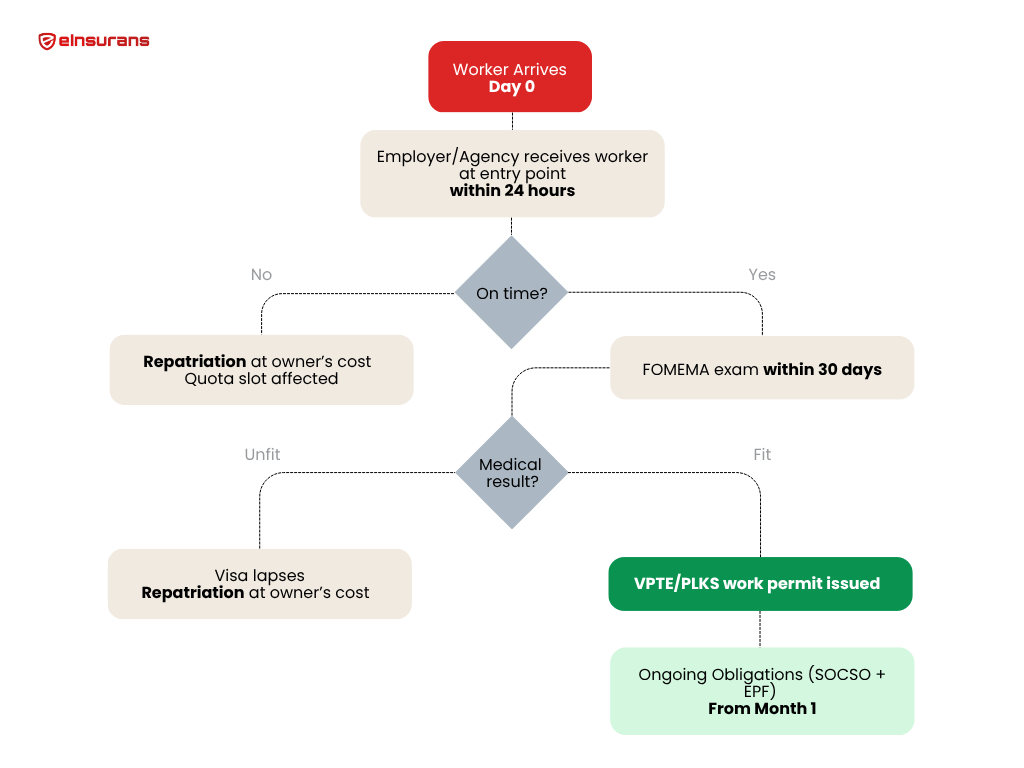
Employers, or their authorized representatives (generally a KDN-licensed recruitment agency), are required to receive workers at the designated entry point within 24 hours of arrival.
If arrival confirmation is not completed within this window, workers may be repatriated to their country of origin at the employer’s expense. The associated quota slot may also be affected, potentially requiring employers to restart portions of the approval process.
How Does the 30-Day FOMEMA Requirement Work?
Newly arrived foreign workers are required to complete a FOMEMA medical examination within 30 days of arrival. Extensions are generally not granted.
FOMEMA screens for infectious diseases, chronic conditions, and general fitness to work. If a worker is declared Unfit, the temporary entry visa lapses, and the employer is required to arrange repatriation at the employer’s expense.
Only once the worker is certified Fit can the employer proceed to apply for the VPTE/PLKS, which is the actual work permit covering the employment period.
Ongoing SOCSO and EPF Payroll Obligations
Once the VPTE/PLKS is issued, statutory payroll obligations apply from the first month of employment.
- Social Security Organisation (SOCSO/PERKESO): Registration is mandatory. Foreign workers must enroll in the Employment Injury Scheme for coverage of work-related accidents, occupational diseases, and long-term disability.
Under the Employees’ Social Security Act 1969, the employer contribution is 1.75% of wages and the worker contribution is 0.5%.
Employers who fail to register workers under SOCSO may be penalised up to RM10,000, imprisonment of up to two years, or both under the same Act. - Employees Provident Fund (EPF): Starting 1 October 2025, contributions for non-Malaysian employees are mandatory, with both employer and worker contributing 2% of monthly wages.
This applies to all foreign workers with a valid work pass, excluding domestic servants.
EPF contributions should be paid by the 15th of the following month. Late payments may attract interest charges and can trigger further EPF compliance reviews.
The Complete Employer Compliance Checklist
For employers who want a single, scannable reference, the table below consolidates all requirements covered above into a stage-by-stage compliance checklist.
Stage 1: Before Recruitment Begins
Stage 2: Before the VDR Is Issued
Stage 3: Within 24 Hours of Worker Arrival
Stage 4: Within 30 Days of Arrival
Stage 5: From the First Month of Employment (Ongoing)
Streamlining Foreign Worker Compliance with eInsurans
Legal responsibility for every stage of the recruitment process rests with the employer, even when a licensed recruitment agency manages the day-to-day execution.
Planning each requirement ahead of time, rather than reacting to it, is what separates a smooth recruitment cycle from a stalled one.
Mandatory insurance is one of the most time-sensitive gates, which is where a purpose-built digital platform can save employers meaningful time.
Why employers choose eInsurans
- Instant FWCMS integration via direct API, so permit applications move forward without manual follow-up
- 99.9% uptime on Financial Link’s trusted infrastructure, a stable alternative when other systems experience downtime
- FPX B2B payment support for corporations running Maker-Checker banking workflows
- Real insurance specialists handling both insurance queries and FWCMS troubleshooting
Stay ahead at every stage of the hiring journey and purchase your SPIKPA IG bundle with eInsurans today.
Trusted Foreign Worker Insurance Solutions
Digital SPIKPA IG insurance with seamless FWCMS integration, secure payments, and real human support.