

Foreign Worker Absconded in Malaysia: What to Do Next

When a foreign worker absconds in Malaysia, report it through FWCMS’s eWorker Runaway (eRUNAWAY) module within 30 days of the date they went missing. 

The security bond tied to that worker is confiscated either way, and your company’s own compliance restriction is temporary, separate from the worker’s own indefinite blacklist. This guide covers the current eRUNAWAY process and what it costs.

Key Takeaways

  • File through eRUNAWAY: FWCMS’s dedicated module for absconded worker reports, not the older manual IMI process still listed on some sites.
  • Document checklist: A police report, SSM certificate, employer/director ID, insurance/bank guarantee copy, and the worker’s passport (front and back).
  • Your money: The security bond is confiscated and not returned. FWIG cannot be used to pay the “sita fine”.
  • Blacklist distinction: The worker faces an indefinite blacklist; your company’s restriction is temporary and lifts once the “sita payment” clears.
  • Decision rule: If contact attempts go nowhere after a few days, file rather than wait. The 30-day clock runs from when the worker went missing, not when you act.
  • eInsurans can help. Skip the hassle and WhatsApp our team at +601156216906 for guidance and support.

What Counts as an Absconded Foreign Worker in Malaysia?

What Counts as an Absconded Foreign Worker in Malaysia Section Image

Source: The Guardian 

You’re not sure yet whether this is an HR, immigration, or insurance problem. It’s actually all three, and the steps below sort them out.

A foreign worker is considered absconded in Malaysia when they leave the workplace without notifying the employer, with clear intent not to return, or fail to return to work after a home visit. If your worker has been unreachable for several days with no explanation, this is the process to follow.

A worker missing a few days isn’t automatically abscondment; it becomes abscondment when there’s no communication, no valid explanation, and a pattern of genuine intent not to return. Section 2 covers the contact-attempt steps to confirm this.

This guide covers corporate foreign workers under FWCMS/eRUNAWAY, not foreign domestic helpers, who fall under a separate immigration process and eInsurans product (foreign worker insurance).

FWCMS has a dedicated digital module for this, called eRUNAWAY (Section 3 explains how it works). Following the process correctly protects your standing with the Immigration Department of Malaysia (JIM).

Read more: Still early in the hiring process and want the full picture before something like this comes up? Our guide to foreign worker recruitment in Malaysia walks through the stages from approvals to onboarding.


Malaysia's Trusted Foreign Worker Insurance One-Stop Centre

SPIKPA IG insurance with seamless FWCMS integration, secure payments, and real human support.

Before You File: What to Do in the First Few Hours

Before You File What to Do in the First Few Hours Section Image

Source: Magnific

Before filing an eRUNAWAY report, contact the worker through every available channel and document each attempt. This record supports your application and shows good faith before you formally report the case.

Start with the basics:

  • Call the worker’s phone, check the hostel or accommodation, and contact any listed emergency contact.
  • Ask coworkers whether anyone has heard from them or knows their whereabouts.
  • Keep a simple written log: date, time, contact method, outcome. Not formal, just good practice supporting Section 3’s documents.
  • Start gathering documents now: your SSM certificate copy, employer/director ID, and the worker’s passport copy, while still attempting contact.
  • File the police report as soon as abscondment is confirmed. It’s one of the five eRUNAWAY documents and usually takes the longest, so start early to avoid delaying your FWCMS submission.


Don’t wait indefinitely. Once contact attempts are exhausted with no valid explanation, file rather than wait. The 30-day window covered in Section 3 runs from the date the worker went missing, not the date you act, so waiting erodes your buffer.

If the worker later returns or provides a valid explanation, you can update the case with Immigration. Filing after a genuine, documented attempt isn’t an overreaction. Our employer requirements checklist covers what else FWCMS expects at each stage.

How to Report an Absconded Worker Through FWCMS (eRUNAWAY)

FWCMS handles absconded foreign worker reports through eRUNAWAY, a dedicated digital module requiring five documents; the current list differs from the older manual IMI checklist still circulating online.

eRUNAWAY Documents Checklist

Document

Notes

Certified police report

Usually takes longest; start this first

SSM certificate copy

Confirms your company registration

Employer or director ID copy

Identifies the reporting party

Insurance or bank guarantee copy

Your FWIG/security bond documentation

Worker’s passport, front and back

Confirms worker identity

A similar list appears elsewhere online. Immigration’s Foreign Domestic Helper (FDH) page sets a comparable process for maids: a letter to cancel the worker’s PL(KS), copies of the employer’s/representative’s ID and the worker’s passport.

The Foreign Worker Abscondment Report Form, and a certified police report, plus blacklisting and a bail payment on the signed personal bond. That’s specific to domestic helpers; the corporate eRUNAWAY requirement is the five items in Table 1, confirmed on FWCMS’s Help Centre.

Some sources also mention a PLKS cancellation letter. Online eRUNAWAY treats it as optional, though physical counter submissions often still require one alongside the police report and abscondment forms.

One eRUNAWAY application covers exactly one worker; no batching, even for simultaneous cases.

Report within 30 days of the date the worker went missing, the most consistently cited window across compliance sources, though not confirmed as an exact day-count. Confirm current guidance if you’re inside a tight window.

The filing sequence runs in order:

  1. Confirm abscondment and complete your contact-attempt documentation.
  2. File a police report and obtain a certified copy.
  3. Gather the remaining four documents.
  4. Submit the eRUNAWAY application through the FWCMS employer portal.
  5. Wait for Immigration to review and approve the application.
  6. Receive an email notification once approved.
  7. Visit the Immigration counter (Bahagian Penguatkuasaan) to pay the sita via bank draft.


“Sita payment” (an administrative fine or security bond forfeiture) must be made via bank draft at the counter, typically to “Ketua Pengarah Imigresen Malaysia” for federal approvals or the relevant state Immigration director for state-level approvals; confirm the exact payee locally, as this convention wasn’t confirmed specifically for sita .

For related FWCMS questions, the eInsurans Help Centre is worth bookmarking.

Filing correctly protects your standing with Immigration. 

What Happens to Your Security Bond and FWIG Insurance

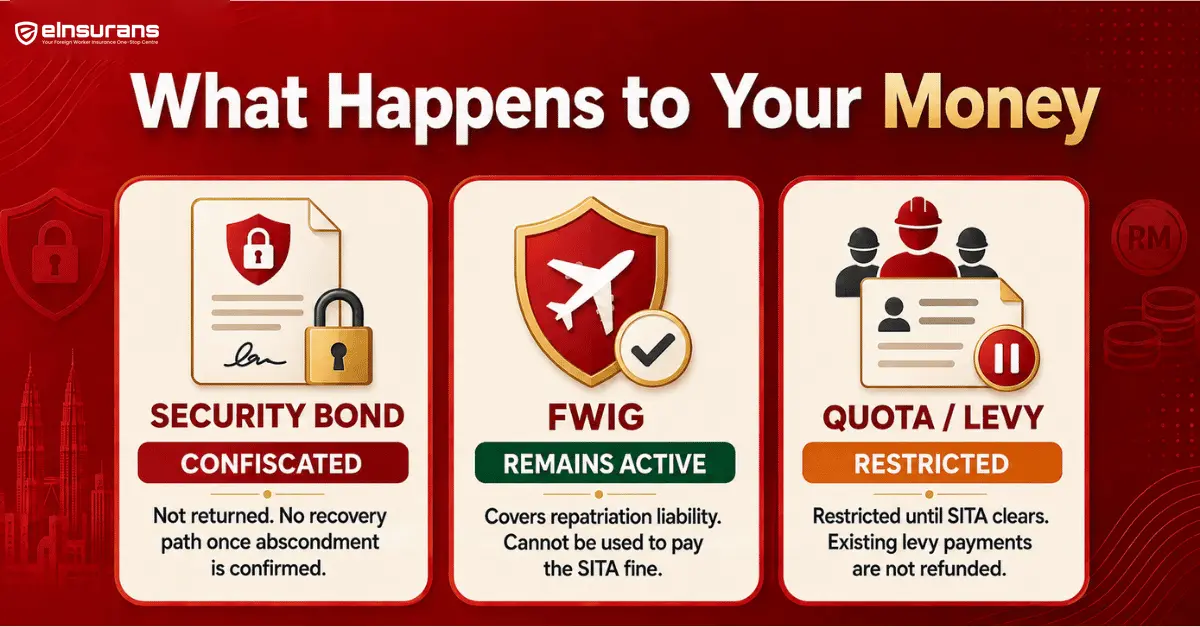
No, you cannot use your Foreign Worker Insurance Guarantee (FWIG) for “sita payment” when a worker absconds. Payment must be made via bank draft at the Immigration counter. The security bond itself is confiscated once abscondment is confirmed and isn’t returned to the employer.

Once a worker is confirmed absconded, the security bond is gone, with no exceptions. Focus instead on what’s within your control: keeping the rest of your workforce compliant.

Myth: “I can use my FWIG insurance to pay the sita fine.” Fact: Confirmed independently across two FWCMS FAQ sources, the sita payment cannot be auto-deducted from the Insurance Guarantee and must be paid via bank draft at the Immigration counter.

So what does FWIG protect? It funds repatriation-related costs and protects the worker from being stranded; it doesn’t compensate for business loss or replace the confiscated bond. Our guide on what an insurance guarantee is and how it protects foreign workers covers this further.
Infographic of What Happens to Your Money

Per Immigration’s Security Bond/Bank Guarantee Rates, the rate is RM500 for Indonesia and RM300 for Thailand; RM1,500 covers Vietnam, China, Cambodia, Bangladesh, India, Myanmar, Sri Lanka, Pakistan, Nepal, and the Philippines, either listed directly or under Immigration’s catch-all rate for other countries. 

You also can’t cancel the absconded worker’s FWIG immediately; it generally stays active to cover repatriation-related liabilities until Immigration formally closes the case.  

eInsurans’s guidance confirms FWIG premiums are non-refundable once issued and activated with Immigration, even if the worker resigns, is terminated, or returns home early. What happens to the SPIKPA (FWHS) hospitalisation premium in an abscondment case hasn’t been separately confirmed on eInsurans’s site. 

Keep FWIG and SPIKPA active for remaining workers through FWCMS’s “Offline Purchase Insurance – Self Insurance Purchase” path on eInsurans.

The bond is gone either way. The next question: does this follow your company the way it follows the worker?

Does This Blacklist My Whole Company? Employer vs. Worker Consequences

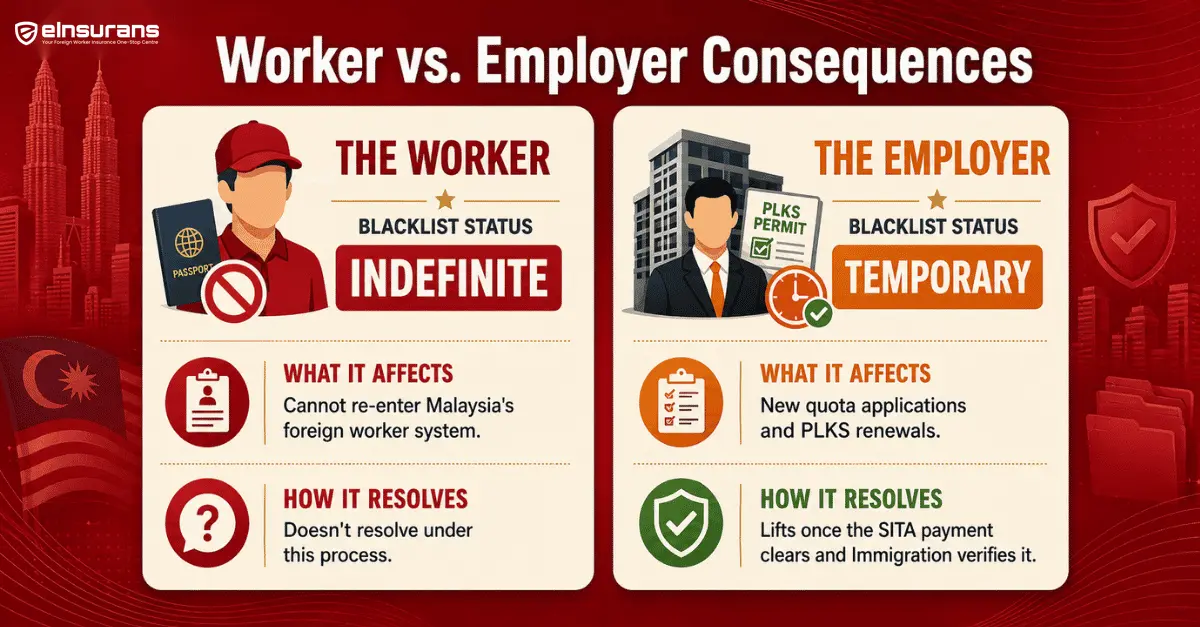
No, a foreign worker’s abscondment doesn’t permanently blacklist your entire company. The worker faces an indefinite blacklist; your company instead faces a temporary restriction on specific transactions, such as PLKS renewals and new quota applications, lifted once the “sita payment” is made and verified.
Infographic of Worker vs Employer Consequences

The worker-versus-employer distinction is confirmed on two independent FWCMS FAQ sources with identical wording. Other workers’ permits are generally processed independently, provided their documentation and insurance remain valid; the restriction applies to specific transactions only.

Filing eRUNAWAY correctly and promptly, then paying the sita once notified, keeps your restriction temporary rather than dragging on.

The next question is how to avoid facing this again.

Read more: Wondering whether your existing coverage actually responds to a situation like this? Our SOCSO vs SPIKPA comparison breaks down what each scheme covers and where the gaps sit.

How to Reduce the Risk of Future Abscondment

How to Reduce the Risk of Future Abscondment Section Image

Source: Magnific

Common preventive steps include regular check-ins, timely and correct salary payments, addressing grievances early, and accurate attendance and communication records. None guarantee a worker won’t leave, but they reduce the likelihood and strengthen your documentation if abscondment happens anyway.

Periodic, informal check-ins surface problems before someone simply leaves. Many abscondment cases trace back to unaddressed grievances or workers with no channel to raise concerns.

Salary disputes, from late payment, incorrect deductions, or unclear pay, are common preventable triggers for abscondment and directly within your control.

Keep accurate attendance and communication records; this supports prevention and, if abscondment happens anyway, the good-faith documentation from Section 2.

One case is a personnel incident. Two or three within a few months is a pattern worth investigating, whether that means reviewing working conditions, pay practices, or hostel management under JTKSM rather than treating each one as isolated bad luck.

Read more: Rebuilding your workforce plan after an incident like this? Our cost-to-hire breakdown covers what to budget for when bringing in a replacement worker.


Conclusion

When a foreign worker absconds in Malaysia, the priority is filing through FWCMS’s eRUNAWAY module within 30 days, using the correct five-document checklist. The security bond attached to that worker is confiscated either way, and FWIG cannot be used to pay the resulting sita fine.

What matters most: the worker faces an indefinite blacklist, while your company faces a temporary restriction that lifts once the sita payment clears. Filing correctly and promptly keeps that restriction short.

How eInsurans Can Help

When a foreign worker absconds, the last thing you need is to spend more time chasing insurance updates, claims or documentation. eInsurans is your one-stop centre for foreign worker insurance, helping Malaysian employers manage SPIKPA IG and FWIG compliance with less hassle.

Our services are integrated with FWCMS, so your insurance purchase is automatically updated in the government portal. You can purchase SPIKPA IG using your FWCMS ITR in just minutes, then continue with the same team for FWCMS support, endorsements, claims and renewals.

  • Real-time FWCMS syncing: Insurance purchases are updated automatically, reducing the need to wait for manual updates during permit renewal.
  • Insurance + FWCMS expertise: Our team understands both the insurance and permit-renewal processes, so you get practical support instead of being passed between different teams.
  • Real people on WhatsApp: Get assistance from our team from 9am–6pm, Monday to Sunday.
  • Proven experience: Since 2023, we have served 8,000+ Malaysian employers and manage 50,000+ active policies, including employers such as Jaya Grocer, BOH, OldTown and Lotus Desaru.


Buying the policy is only the first step. What matters just as much is having someone to turn to when a status does not update, a claim needs following up, a worker’s details change, or you need a refund for a worker who never arrived.

With eInsurans, you get more than a policy—you get a team to help manage what comes after.

Have questions specific to your case? WhatsApp our team at +601156216906 for guidance from real people. 

Malaysia's Trusted Foreign Worker Insurance One-Stop Centre

SPIKPA IG insurance with seamless FWCMS integration, secure payments, and real human support.