Foreign Worker Post-Arrival Checklist Malaysia: A 30-Day Employer Timeline
Bringing a new cohort of foreign workers into Malaysia is a significant operational investment, and most of the risk sits in the first 30 days, not the recruitment stage.
Employers who run into trouble here are rarely dealing with a paperwork error. They’re dealing with a sequencing error, a missed deadline, or two compliance tracks run as if they were one.
This foreign worker post-arrival checklist for Malaysia covers everything an employer must do in that window: physical clearance at the entry point, hostel certification under Act 446, statutory registration with SOCSO, and the FOMEMA medical screening, each with its own deadline and its own consequence for missing it.
Key Takeaways
- Clear arrival within 24 hours: The employer or authorised representative must receive and clear the worker
- Confirm certified accommodation: House workers only at the approved JTKSM address
Register with PERKESO promptly: Complete registration so statutory coverage can begin
- Verify EPF before first payroll: Confirm registration and apply the correct contribution rate
- Register FOMEMA early: Register within 72 hours and complete the medical examination within 30 days
- Check FWHS/SPIKPA policy: Verify coverage during the worker’s first week
What Must Employers Do After a Foreign Worker Arrives in Malaysia?
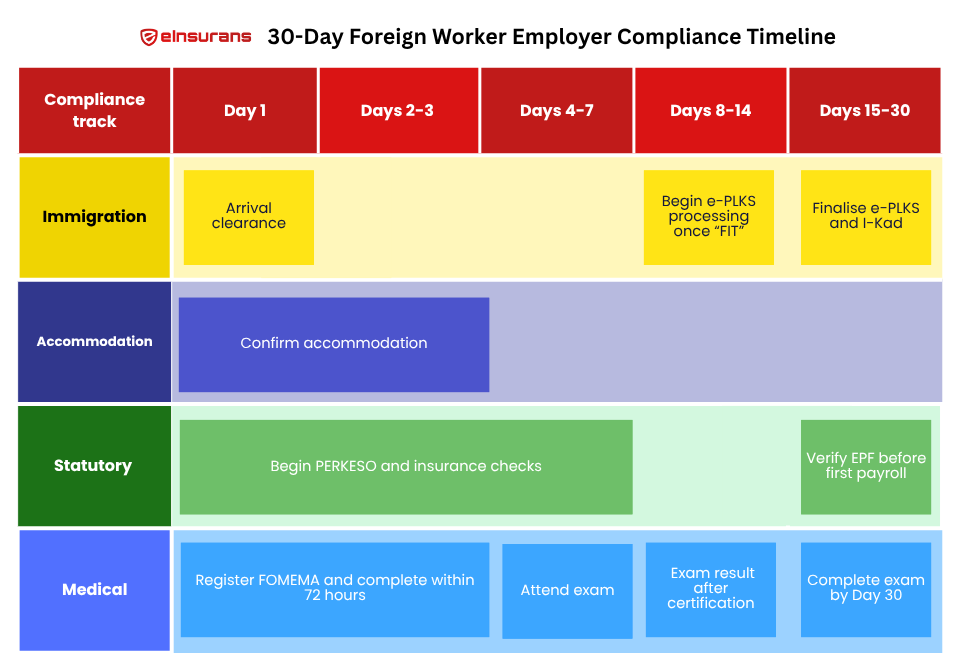
Employers managing foreign workers in Malaysia must complete seven steps across four compliance tracks within the first 30 days: immigration, accommodation, statutory registration, and medical clearance.
Most recruitment guides stop when the worker lands. This section explains what employers must complete next, from arrival clearance and accommodation confirmation to PERKESO checks, FOMEMA clearance, and final work pass documentation.
These obligations do not follow one simple sequence. Several run in parallel, so treating them as a single checklist can lead to missed deadlines.
The swimlane timeline below shows how the seven post-arrival steps overlap across the first 30 days in Malaysia:
Step 1: Immigration - Complete Arrival Clearance Within 24 Hours
The compliance clock starts at the airport. Malaysian Immigration requires the employer or an authorised agency representative to receive and clear the worker at the designated entry point, such as the Kuala Lumpur International Airport (KLIA), within 24 hours of arrival.
Once the worker clears immigration, HR should log into the FWCMS portal and update the worker’s status to “Arrived.” This is what unlocks the compliance steps below.
Step 2: Accommodation - Confirm Act 446 Accommodation Before Occupancy
Workers should not be placed in uncertified accommodation while other paperwork is still being processed.
Before deploying new arrivals to a job site, employers must confirm that the accommodation complies with the Employees’ Minimum Standards of Housing, Accommodations and Amenities Act 1990 (Act 446), administered by the Department of Labour Peninsular Malaysia (JTKSM).
Your JTKSM hostel inspection checklist should confirm:
- The physical premises match the address on the employer’s valid Certificate for Accommodation
- JTKSM is notified within 30 days of worker occupancy
- The correct regional rules are followed, as Act 446 applies in Peninsular Malaysia and the Federal Territory of Labuan, while Sabah and Sarawak have separate labour requirements.
Mismatches between worker headcounts and the certified address are a common trigger for Ministry of Human Resources (KESUMA) labour audits and one of the most common foreign worker recruitment mistakes employers make during the post-arrival window.
Step 3: Statutory - Register Workers with PERKESO Immediately
Employers must register eligible foreign workers with the Social Security Organisation (SOCSO) a.k.a PERKESO, through the digital ASSIST portal and begin contributions within 30 days of employment commencing, so statutory coverage is in place on time.
Eligible foreign workers are covered under PERKESO’s three policies: Employment Injury Scheme, Invalidity Scheme and LINDUNG 24 Jam (officially the Skim Kemalangan Bukan Bencana Kerja, or SKBBK), depending on the applicable contribution category.
LINDUNG 24 Jam took effect on 1 June 2026 and provides protection for accidents outside working hours. During Phase 1, its 0.75% contribution is fully employee-funded. Other applicable PERKESO contributions remain separate.
Employers are responsible for deducting and remitting the required employee contributions, together with any applicable employer contributions, through the normal payroll process.
Step 4: Statutory - Verify FWHS/SPIKPA Insurance in the First Week
Employers should verify each worker’s FWHS/SPIKPA insurance during the first week and confirm that the policy status is reflected correctly in FWCMS.
FWHS/SPIKPA is separate from PERKESO and FOMEMA. Employers must also arrange the Foreign Worker Insurance Guarantee (FWIG) required for the applicable immigration process.
Before moving on, confirm that:
- The worker has active FWHS/SPIKPA coverage;
- The policy status is reflected correctly in FWCMS;
- The policy documents are saved in the worker’s records
- Any errors or missing updates are resolved promptly.
Checking coverage early helps reduce delays later in the 30-day post-arrival process.
Employers can purchase SPIKPA and FWIG through insurance platforms such as eInsurans.
For a detailed walkthrough, see How to Purchase FWCMS Foreign Worker Insurance via eInsurans.
Trusted Foreign Worker Insurance Solutions
Digital SPIKPA IG insurance with seamless FWCMS integration, secure payments, and real human support.
Step 5: Statutory - Verify EPF Registration Before First Payroll
Eligible foreign workers must also be covered under the Employees Provident Fund (EPF). Since October 2025, both employer and employee contribute 2% of monthly wages each for most eligible non-Malaysian employees.
Employers should:
- Verify the worker’s registration through i-Akaun Employer
- Confirm that any automatic registration has been completed successfully
- Ensure payroll applies the correct contribution rates before the first salary cycle
Where automatic registration is unsuccessful, follow the instructions in the EPF notice promptly.
Step 6: Medical - Complete FOMEMA Within the First 30 Days
Register newly arrived foreign workers with FOMEMA within 72 hours of arrival. The medical examination should then be completed within the applicable 30-day window.
Once registered, arrange the examination at an accredited FOMEMA panel clinic. The screening typically includes:
- A physical examination;
- Blood tests
- Urine screening
- A chest X-ray
If the worker receives an “UNFIT” result, the employer must follow the applicable appeal or repatriation process. Where repatriation is required, the employer must apply for a Check Out Memo and arrange the worker’s return.
For the next steps, read Foreign Worker Fails FOMEMA: What Employers Must Do.
Step 7: Immigration - Finalise e-PLKS and I-Kad After a “FIT” Result
Once FOMEMA transmits a “FIT” status, employers move into the final stage of foreign worker onboarding: permanent documentation.
- e-PLKS sticker: HR uploads passport scans and temporary visa details to apply for
the Temporary Employment Pass (PLKS/VPTE) through the Immigration e-PLKS portal.
Paying the applicable processing fees converts the worker’s temporary status into a valid, year-long employment pass.
This first-year issuance follows a similar system logic to the foreign worker permit renewal process that employers will repeat in subsequent years.
- Foreign worker I-Kad for employer records: The final step is the biometric I-Kad, issued by the Immigration Department as the worker’s identity document.
The physical card goes to the worker; thus, HR should keep clear copies of the I-Kad and the signed employment contract on file.
30-Day Post-Arrival Checklist
Treat the First 30 Days as an Active Timeline

Employers who manage the post-arrival window proactively are less likely to miss overlapping requirements, face documentation delays, or be caught unprepared for a JTKSM or Immigration audit.
Keep completed forms, policy documents, screening results, and statutory registration records together in each worker’s personnel file. Confirm the required retention period with your HR or compliance adviser.
For the insurance step, employers use eInsurans for:
- Automatic FWCMS updates: The worker’s insurance status is updated after payment confirmation.
- FPX B2B payments: Supports Maker-Checker workflows for corporate finance teams.
- 24/7 access: Policies can be purchased outside normal business hours.
- Specialist support: Insurance specialists assist with coverage and FWCMS-related queries.
- Proven employer adoption: More than 50,000 active policies across employers including Jaya Grocer, BOH, OldTown, and Lotus Desaru Beach Resort.
Trusted Foreign Worker Insurance Solutions
Digital SPIKPA IG insurance with seamless FWCMS integration, secure payments, and real human support.